
By Day 6, long levees were starting to blur together. Toruń, Chełmno and Grudziądz broke the monotony just enough to make the lower Vistula feel different.
Trip date: 9 July 2026
Route: Bobrowniki – Toruń – Ostromecko – Chełmno – Grudziądz
Distance: 156 km
Day 6 started like the previous days.
Wake up around 5:30, spend about an hour getting ready, then start cycling around 6:30. By then the daily rhythm was fixed. What changed each day was the surface, the weather, the stops and how tired we were when the next problem appeared.
We were still off route after the accommodation search from the evening before, so the first job was simple: ride the extra five or six kilometres back towards Bobrowniki and return to the Wisła 1200 route.
Before Toruń, the route went through bushes, sand and very narrow overgrown lines. I wouldn’t really call them bicycle tracks. In places, even walking would have been awkward. Riding loaded bikes through that was slow and annoying.

I remember thinking about the guys from Wadowice, who had gone through that area at night the day before. I still don’t know how they managed it.
By around 9:00, we reached Żabka in Silno.
That was breakfast. Pizza, something to drink, and a proper pause after the first difficult section. It wasn’t special food, but it worked.
From Silno, Toruń was close.
Toruń was the first old town that broke the rhythm of the day.
We met the guys from Wadowice again. There was also a rider from Toruń who’d already finished the whole Wisła 1200. He was relaxing on the boulevard and started telling us about the sections before and after Grudziądz: singletracks, difficult places, and parts where even he had to walk his bike.
That was useful information, but not exactly comforting.
I knew Toruń already and had been there before, so it wasn’t a discovery for me. But it still worked as the first old-town interruption of the day. After the narrow tracks, sand and morning fatigue, the brick city centre and the Vistula boulevard changed the rhythm for a moment.
Toruń is worth mentioning here because it isn’t only an attractive old town. It is a well-preserved medieval trading and administrative centre on the Vistula, recognised by UNESCO. Its Old Town and New Town keep many Gothic brick buildings, and that river-trade background fits the wider lower Vistula story.
After Toruń, the day returned to roads, tracks, fields and wind.
At some point, the ride became less about places and more about keeping the body moving. The main problems were general tiredness and wind. By Day 6, everything was already adding up. My ring and little fingers had probably started going numb the day before, but on Day 6 I could definitely feel it.
That is one of those small things that tells you the ride is no longer fresh.
You can still pedal. You can still talk. You can still stop, eat and continue. But the body starts reporting problems in the background.
Ostromecko became the next proper stop.

We stopped in a restaurant and had a proper meal. Afterwards we got supplies and water from Żabka and continued.
In the restaurant, another Wisła 1200 rider was so tired that he was falling asleep while eating soup. We met him again later on the route. It was a small scene, but it said a lot about this stage of the ride.
After Ostromecko, the next old-town interruption was Chełmno.
The approach already felt different. There were better roads for a while, but there were also climbs. They weren’t mountains, just long and sharp enough at that point in the ride. I was tired, so I didn’t push myself to ride everything. I walked part of one climb. Andrzej probably rode it.
That was fine. By Day 6, there was no reason to prove anything on a climb.

Chełmno gave us a slightly longer pause.
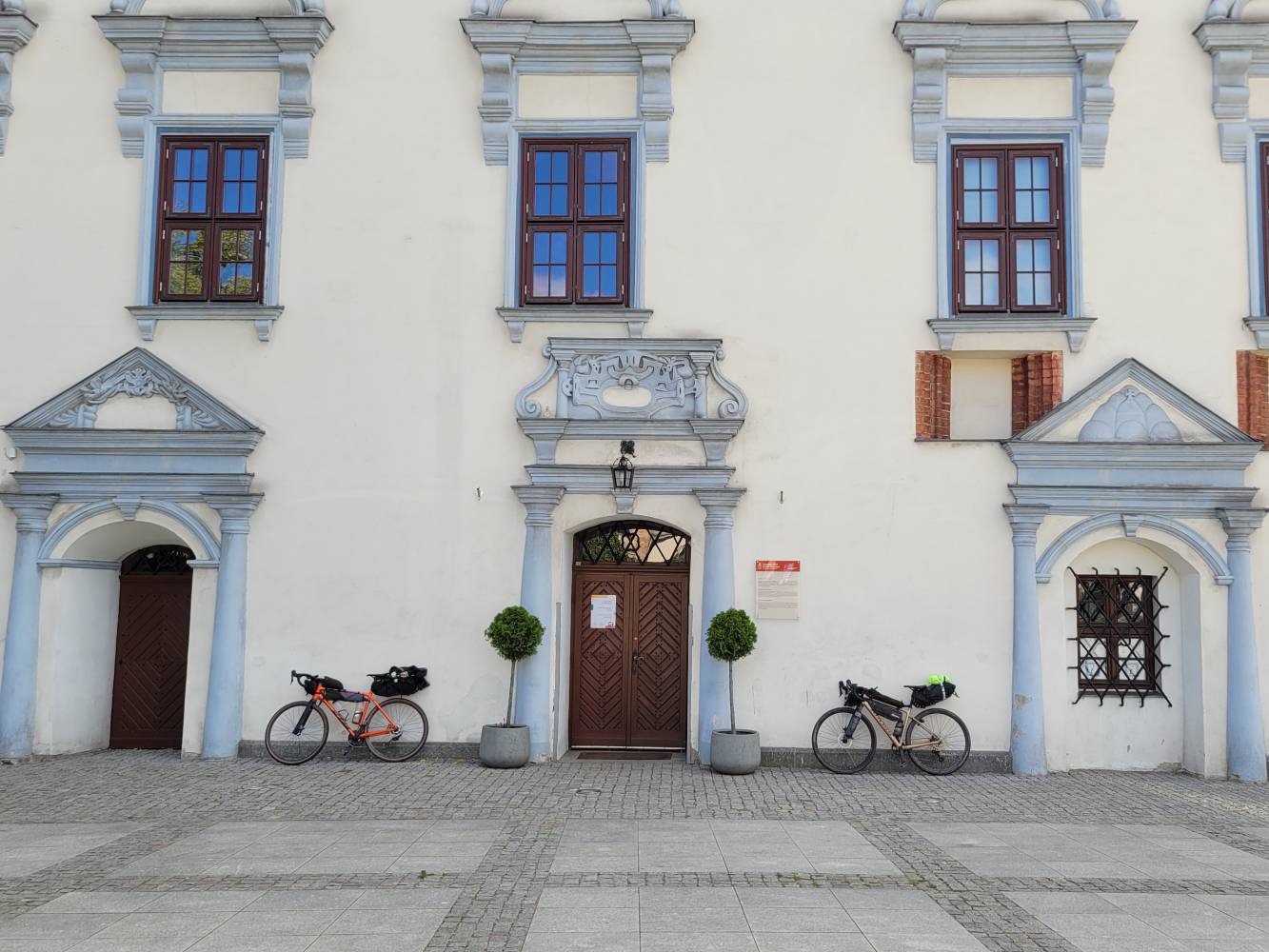
We stopped at Żabka, bought ice cream and drinks, and sat on the market square for a while. I took a photo of the bikes against the old town hall building.

Chełmno stood out because of the setting. It was still a ride stop, but it didn’t feel like another random shop break. The old brick town, the market square and the high location above the Vistula valley made it different from the flat, repetitive riding around it. Chełmno’s old town is listed as a Polish Historical Monument, and its historic layout sits on the high edge of the old Vistula valley.
After Chełmno, the levees returned.
This was the part of the day that later looked better in photos than it felt from the saddle.

I looked at the views. It was not as if I rode completely blind to the landscape. But much of the time I was listening to music in my earphones and watching the front wheel and the surface just ahead of it.
The photos make some of those sections look open and peaceful. They were, in a way. But after several days of riding, a peaceful levee can also become monotonous. If the surface is good, you roll. If it is slow, you lose time. Either way, you keep watching the line in front of the wheel.
The final thirty kilometres towards Grudziądz were partly kind and partly not. Some levee sections let us ride over 20 kilometres per hour. Others dropped us back to 13 or 14. That difference matters late in a day, when the only thing you want is a clear sense of progress.
Before Grudziądz, a local rider appeared.
He was waiting for Wisła 1200 riders because he wanted to ask questions about the event. He was thinking about taking part the following year and wanted to know about the route, logistics and how it really worked.
That was a good moment. We had spent the day dealing with fatigue and repetition, and suddenly someone fresh was looking at the same event from the other side, as something still ahead of him.
He also helped guide us through the final singletrack section before the city.
The Vistula before Grudziądz looked good. I remember that. After so much surface-watching, the river view finally cut through the day.
Then Grudziądz appeared.

We stopped and looked at the riverfront and the granaries. The view was hard to ignore. The brick line above the Vistula made a clear ending to the day.
But the main feeling was simpler than history: relief.
We had reached Grudziądz. We had a nice apartment. The day was over. There was only one day left.
That was enough.
After getting to the apartment, we went for a short walk to a local shop to buy something for supper and breakfast. We knew the final day would be about 150 kilometres, but I do not remember thinking too much about it that evening. The focus was still on ending Day 6 properly: food, shower, sleep.
We had planned to stop beyond Grudziądz, but by then leaving about 150 kilometres for the final day was enough.
The old towns really had broken the monotony. Toruń, Chełmno and Grudziądz did something small but useful. They interrupted the levees, fields, wind, music and wheel-watching. They reminded me that this lower Vistula section had its own shape: brick towns, river trade, high banks, granaries and crossings.
WORTH KNOWING:
Brick Towns of the Lower Vistula
Toruń, Chełmno and Grudziądz are different towns, but all three help explain the brick character of the lower Vistula corridor.
Toruń’s medieval town is recognised by UNESCO as a well-preserved trading and administrative centre on the Vistula. Its Old Town and New Town preserve a large group of Gothic brick buildings, including churches, townhouses and public buildings connected with the city’s medieval importance.
Chełmno is also built around a medieval urban layout. Its old town sits on the high edge of the Vistula valley and is listed as a Polish Historical Monument. The town is useful here because it shows another form of the same lower-river pattern: planned medieval layout, brick architecture and a strong position above the river.
Grudziądz makes the river connection especially visible. Its line of brick granaries stands above the Vistula, and the first brick granaries were built there in the 14th century. Some of them now belong to the Museum of Grudziądz and the Museum of Vistula Trade.
On the bike, I was mostly tired. But the old towns still did their job. They broke the monotony just enough for Day 6 to stay memorable.
The next morning would be the last one. There were no more multi-day calculations left. We had one day to reach the mouth of the river and the official finish.
Sources Used
- Andrzej Chwalba, Wisła. Biografia rzeki. Wydawnictwo Literackie, 2023.
- UNESCO World Heritage Centre, material on the Medieval Town of Toruń.
- National Institute of Cultural Heritage / Zabytek.pl, material on Chełmno Old Town.
- Grudziądz tourist information and Museum of Grudziądz material on the granaries and Vistula trade.
Next Reads
Wisła 1200: Poland Looks Different from the Vistula
The overview of my ride along the Vistula.
Wisła 1200 Day 7: The River Ended Before the Ride Did
The last day of the Wisła 1200 ride.