
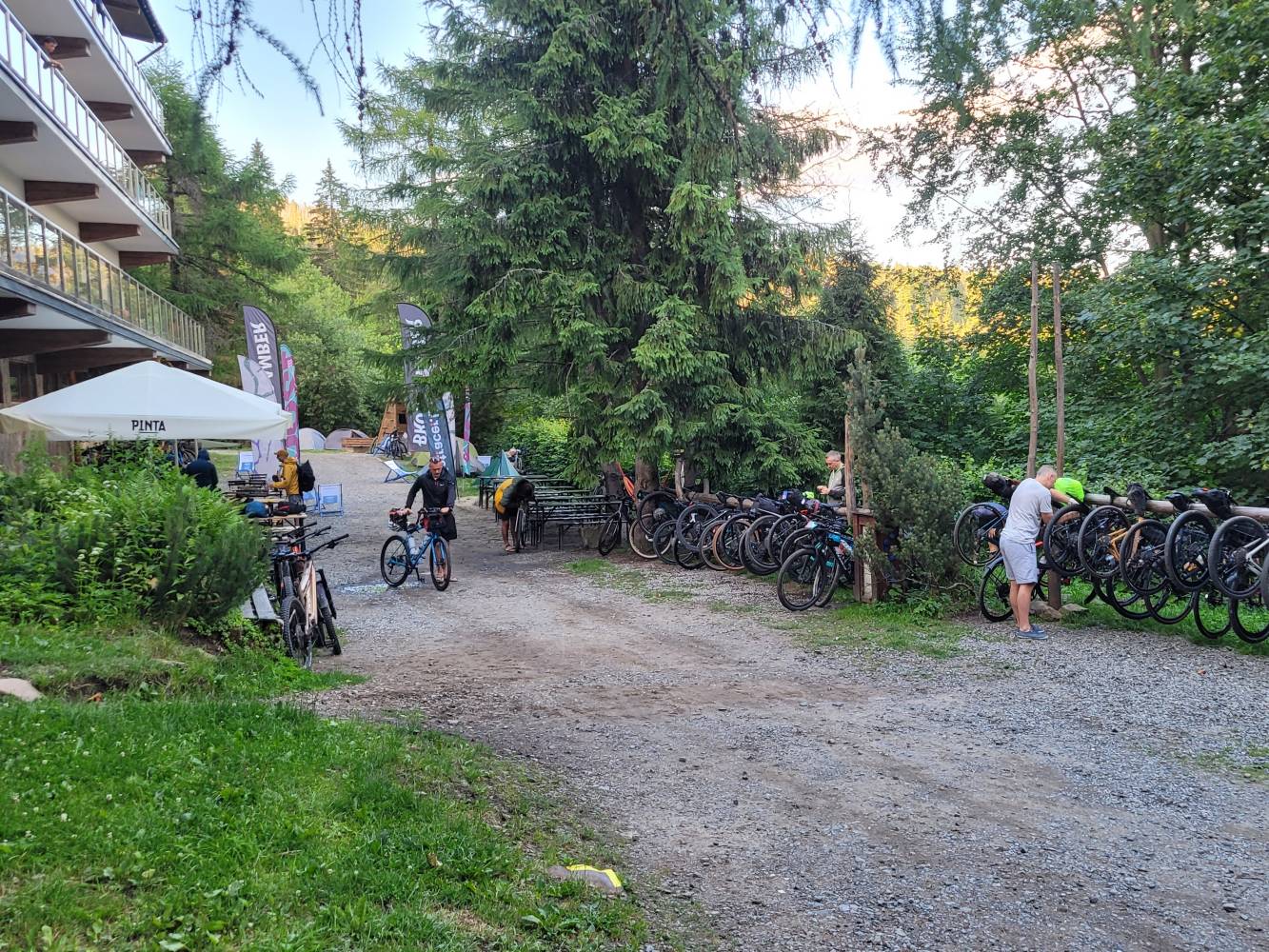
The Wisła 1200 starts before the riding: trains to Barania Góra, a practical start near the source area, then the young Vistula, Jezioro Goczałkowickie, Tyniec and Kraków.
Trip date: 3-4 July 2026
Route: Warsaw – Milówka – Barania Góra source area – Kraków
Distance: 207 km on the Wisła 1200 route, plus the approach to the start
Wisła 1200 didn’t begin with riding.
It began with trains.
First from Warsaw to Kraków. Then from Kraków to Bielsko-Biała. Then further south, towards Milówka and the start area near Barania Góra. Before I could follow the Vistula, I had to get myself and the bike to the place where the route began.
On the way, I met other riders. Some had more experience with long-distance events. Some, like me, were starting Wisła 1200 for the first time. A lot of the conversation was practical. Do not start too fast. Do not race people in the first hours. Eat regularly. Keep breaks short, but don’t skip them completely. Ride slowly enough to keep riding the next day.
That sounded sensible to me.
The route was about 1,200 kilometres long, with a 170-hour limit. So even if Wisła 1200 was officially a race, my plan wasn’t complicated: keep moving, don’t rush at the beginning, and avoid stupid mistakes.
At the shelter near Barania Góra, the evening was mostly about preparation. Bikes, bags, food, lights, clothes, weather, sleep. Nothing very romantic. Just the normal list of things that become important before a long ride.
I also had to make one decision before the start.
I didn’t go to the exact Vistula spring markers.
The ride began in the source area, but visiting the exact markers would have meant extra climbing and extra time before a 1,200-kilometre route. It would have made the beginning more symbolic, but not more practical. I decided that starting from the official route near Barania Góra was enough.
The source markers can wait for another visit.
For this ride, I was already at the beginning.
The Vistula near Barania Góra is not the wide river people usually picture. I knew that before the ride, but starting there made it practical rather than abstract. The river begins through streams and watercourses coming from the slopes: Biała Wisełka, Czarna Wisełka and smaller waters that later form the Wisła.
So the first part of the route wasn’t about a big river beside the road. It was about leaving the mountains and following the beginning of a river system.
The start was in the morning. I woke up after 5, had breakfast around 6, and started at 7:10 in the third wave.
It was cold at first. The first few hundred metres went downhill on stones and gravel, then onto asphalt. Almost immediately, other riders had problems. I remember at least two punctures in the first 50 metres. That was a useful reminder that things can go wrong before the ride has properly begun.
My bike was fine, and we continued downhill.
I was riding with Andrzej, we weren’t trying to prove anything. The aim was to settle into the ride without doing something stupid.
The early kilometres didn’t feel like following a great river. There were roads, villages, descents, gravel, small watercourses and the usual attention to the surface. The Vistula was still young and not always obvious.
After about 30 kilometres, I lost the cap from one of my large bottles. I probably lost it while riding through rougher ground on the levees. The water poured out. It was annoying, especially because the bottle was new, but it wasn’t a disaster. I still had enough capacity to continue, and I hoped I could solve it later in Kraków.
That was the first small lesson of the ride: not every problem needs drama. Some things are just irritating and have to be managed.
The first major difficult section came around Wały Goczałkowickie near Jezioro Goczałkowickie.

Before the ride I knew about the reservoir, but seeing it during the first day changed the scale. The lake had waves and looked almost like a small sea. It wasn’t the wide, sandy, partly wild Vistula I knew from Warsaw. It was a managed water landscape connected with the upper river system.
That was useful to see so early.
The Vistula didn’t become large first as a free, open river. It became large through infrastructure.
WORTH KNOWING:
Jezioro Goczałkowickie
Jezioro Goczałkowickie is an artificial reservoir on the Mała Wisła. It was built after World War II, with construction planned for 1950-1955 and the finished reservoir officially opened in July 1956. The main reasons were practical: water supply for Upper Silesia and Zagłębie, flood protection on the upper Vistula, and later also fishery and environmental functions.
Creating the reservoir meant changing the existing landscape. Parts of nearby villages were flooded, including part of Zarzecze with its church and cemetery, and around 2,000 residents from 428 private farms were resettled. Today the reservoir covers about 32 square kilometres and has become an important wetland and bird habitat, even though it began as a water-management project.
The section itself wasn’t gentle. There were levees, rougher surfaces and the kind of riding that made everyone slow down. The organiser had prepared these “special sections” with visible pleasure. We knew from the briefing and from videos from previous editions that some early parts would be hard. In that year the grass had apparently been cut, so it could’ve been worse.
That isn’t always comforting when you’re already there.
Before the harder part, around 52 kilometres, we stopped at Żabka. Hot dogs, water, a short rest. That kind of stop became part of the language of the ride very quickly. Shops were not background. They were checkpoints.
Later, another rough section came through the beaver area. It was one of those parts that felt designed to test not only legs but patience. At the start of a 1,200-kilometre ride, I was already learning that the route wouldn’t simply follow smooth roads beside a river.
Near Brzezinka, we passed Auschwitz-Birkenau.

I’d never been there before. But even passing beside it made an impression. What struck me was the scale: the number of preserved buildings and the physical size of the place. I’d visited Treblinka and Stutthof before, but here the presence of the camp in the landscape felt different.
There was no way to turn that into a normal cycling note.
We stopped briefly, took a photo, and continued.
After that, the day returned to the usual work of riding: distance, food, route, surface, water, pace. The weather was good after the cold morning, and physically I felt better than I had expected. After 150 kilometres, I was tired but not destroyed. That mattered.
The approach to Kraków gave the day another change of character.
First came Tyniec.

The monastery at Tyniec is one of those places that clearly belongs to the Vistula landscape around Kraków. We didn’t make a long stop there, but it was impossible to miss the connection between the river, the hill and the old buildings.
Further on, the route didn’t simply roll into Kraków on easy paths.
The organiser still had ideas.
We had to climb towards Kopiec Piłsudskiego, and then came descents and paths that felt more suitable for runners or mountain bikes than for loaded gravel bikes after a long day. I remember thinking less about sightseeing and more about not damaging the bike. Hands on the brakes, watch the roots, keep the bike moving.

Kraków itself was another strange contrast.
We rode through one of the most recognisable cities in Poland, but by then it was Saturday evening, crowded, and late in the day. The route even took us through the market square. On a normal trip that might have been the point of the day. On Wisła 1200, it was part of the final push to lodging.
By the time we reached the accommodation in Kraków, we’d ridden about 206 kilometres.
That number mattered. Without it, the first day sounds too abstract. It wasn’t just “from Barania Góra to Kraków.” It was a full day of riding. It also changed the scale of the whole project.
Before the start, Wisła 1200 was still mostly a number. After the first day, it became a route I had actually started. There were still around 1,000 kilometres left, but the beginning was done.
The next day was already a problem to solve.
There was rain in the forecast. It would be Sunday, with fewer shops open. That meant thinking about food, opening hours and how much to carry. The first day didn’t end with a celebration. It ended with the usual long-ride questions: what will the weather do, where will I buy food, and how hard will the next section be?
That was a good introduction to Wisła 1200. Not a calm tour of the upper Vistula.
Before the Vistula looked like the Vistula I knew, the ride had already begun properly.
Sources Used
- Andrzej Chwalba, Wisła. Biografia rzeki. Wydawnictwo Literackie, 2023.
- Mateusz Waligóra and Dominik Szczepański, Szlak Wisły. 1200 km pieszej przygody. Wydawnictwo Otwarte, 2023
- Archiwum Państwowe w Katowicach, U źródeł Wisły – Jezioro Goczałkowickie
- Czechowice. Codziennie, Tak powstało “Śląskie morze”.
Next Reads
Wisła 1200: Poland Looks Different from the Vistula
The overview of my ride along the Vistula.
Wisła 1200 Day 2: When the Ride Became a Routine
The second day of the Wisła 1200 ride.