
Trip date: 20 June 2026
Route: Łeba – beach east of Łeba – Stilo Lighthouse – Łeba
Area: Łeba, Pomorskie, Baltic coast
Łeba sits on Poland’s Baltic coast, and I had been there many times before. We arrived again on Friday evening after work and still had time to walk through town and down towards the beach.
I had first visited Łeba with the same two friends about 22 years earlier. I’ ha’d been back several times since then. In 2008, I also finished a multi-day bike ride with my Dad from Hel to Łeba, passing Stilo on the way. On other trips, I had already explored Słowiński Park Narodowy and the moving dunes.
This time, the interesting direction turned out to be east.

On Saturday morning, the three of us went to the beach. One of my friends was quite happy to stay there and sunbathe. My other friend and I aren’t very good at lying on a beach for hours, so we decided to go for a walk.
Nothing ambitious. Just a few kilometres.
We left our thongs – flip-flops – with our friend on the beach. We had our phones and about half a litre of water each, but no food. There was no reason to carry much for a short beach walk, right?
At least, that was the original logic.
Just keep going
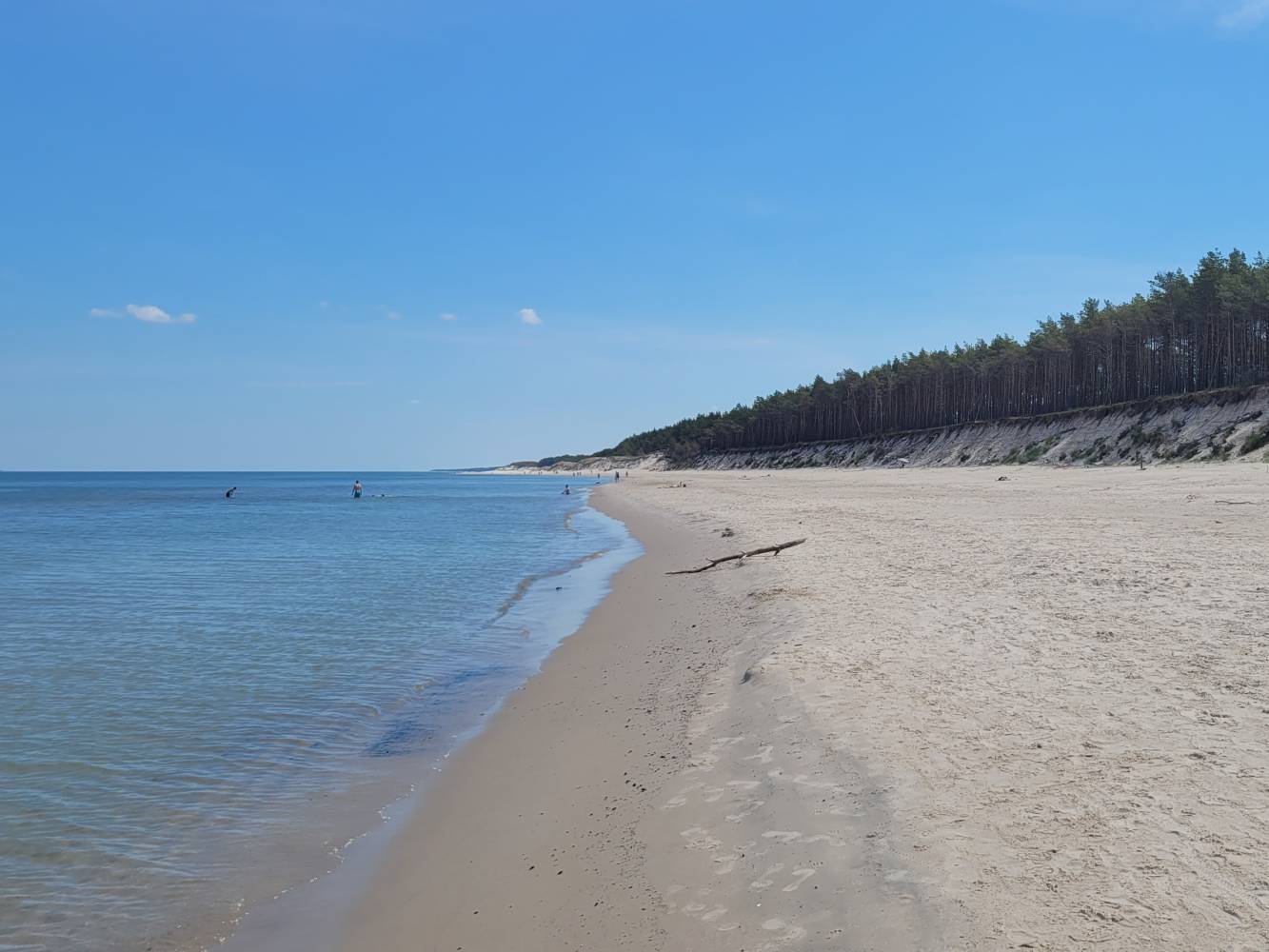
The beach itself made walking easy. It was mostly soft sand, and after a while the busier part near Łeba was behind us.
After about seven or eight kilometres, we checked the map again. Stilo Lighthouse was closer than we expected, and the remaining distance looked manageable.
That changed the decision. If we turned around, we already had seven or eight kilometres to walk back. If we continued, we would at least reach somewhere specific.
So we continued.

There was no moment when we decided to go on a 30 km walk. The original walk simply became longer a few kilometres at a time. Because the plan had been a short walk along the sand, we were still barefoot.
That seemed less clever with every extension of the route.
Something in the water
Somewhere along the beach, we both noticed something sticking out of the sea.
From a distance, neither of us could work out what it was. We discussed whether it might be a tree, some kind of concrete structure or something else.
Then my friend remembered reading about a shipwreck somewhere along this part of the coast.
That gave us a possible answer, but we didn’t know yet.
We kept walking.
Leaving the beach
Eventually, we reached the path that took us away from the shore and into the forest.
We checked the map again and followed the track inland. Then we began to see buildings around the lighthouse area. Finally, the lighthouse itself appeared.
By then we had walked around 15 km.
The change of surface also made our lack of footwear much more noticeable. Bare feet on sand were one thing. Bare feet on forest tracks and gravel were another.

We sat on a bench for a while and called our friend back in Łeba to let him know where we were. Then we read the information boards and checked whether we could buy something nearby. We’d started with only half a litre of water each which made perfect sense for a short walk we had planned and rather less sense for the walk we were now doing.
We didn’t climb the lighthouse. It was getting later, our feet were already feeling the distance, we still had to get back to Łeba, and we were thinking about food and water.
We had reached the destination. That was enough for this visit.
WORTH KNOWING:
Stilo Lighthouse
The present Stilo Lighthouse was completed in 1906. The tower is a steel structure built on concrete foundations, with a sixteen-sided body that narrows towards the top. Its black, white and red bands make it easy to recognise.
The information at Stilo also shows the tower’s original lantern, optics and machinery. An earlier light had operated farther north before the present lighthouse was built. A plaque connected with the tower carries the name Julius Pintsch of Berlin and the year 1906. The lighthouse has been open to visitors since 1992.
Unlike a lighthouse standing directly on the shoreline, Stilo is set inland among the coastal forest and dunes.
The mystery gets an answer
The information near Stilo also answered the question from earlier.
The strange object in the sea was connected with the wreck of West Star.
We first noticed something we couldn’t explain, talked about what it might be, and only later found the story behind it. That sequence is what made the wreck more interesting to me than if I had simply read about it before setting off.
On the way back, I stopped to photograph it.

WORTH KNOWING:
The West Star Wreck
West Star was a small cargo vessel built in Bremen in 1965. It was about 62 metres long and sailed under different names and owners before becoming West Star.
In late October 1970, the ship left Gdańsk for Wivenhoe in England carrying timber. During a strong storm, the cargo shifted, the vessel developed a serious list and water entered the engine room. Rescue attempts followed, but the ship was eventually lost near this part of the coast. Waves and sand continued to break up the wreck afterwards.
Today, the remains lie roughly 200 metres offshore in relatively shallow water. Parts still rise above the surface.
Now we had to get back
Reaching Stilo solved one problem and created another.
We were around 15 km into the walk.
One option was to walk roughly 800 metres towards the nearby settlement and try to find a melex, one of the small electric tourist vehicles commonly used around Polish seaside towns.
My friend preferred another solution: walk back.
He didn’t need to work very hard to convince me. I like adventures too, including some that aren’t especially smart.
So we went back towards the beach and turned in the direction of Łeba.
Thinking about the return now, I mostly remember that we simply walked. We didn’t spend the whole time calculating what remained or debating whether walking back had been a good decision.
Łeba was in that direction, so that was where we went.
The conditions were less helpful than they had seemed in the morning. It was above 30°C, there were no clouds, and there was almost nowhere on the open beach to get out of the sun.
The sand was still mostly soft, but distance changes things. Around 30 km barefoot is still around 30 km barefoot.
By the return, blisters were becoming part of the day.
Eventually, we reached Łeba again and reunited with our friend.
And with our thongs.
Food became more important than history
Afterwards, we went into Łeba for dinner.
I had potato pancakes with salmon, and also had śledź po kaszubsku, Kashubian-style herring.
That was enough for Saturday.

The run that didn’t happen
We had another plan for Sunday morning. We were going to run towards Słowiński Park Narodowy.
Our feet settled that question quickly.
The blisters and soreness from Saturday were enough to cancel the run. Instead, I took a short walk around Łeba before heading towards Lębork for the train back to Warsaw.
I’d already visited Łeba many times, but never went to the east of the town – thanks to that I learnt about the nearby shipwreck.
A few kilometres on the beach had become a lighthouse, a shipwreck story and around 30 km on bare feet.
I would happily walk towards Stilo again.
Next time, I would take the thongs with me.
Sources Used / Further Reading
- Information boards photographed at Stilo during the June 2026 visit
- DivingBaltic.pl, West Star – 3m
- WrakiBaltyku.pl, West Star
- Towarzystwo Przyjaciół Narodowego Muzeum Morskiego, Latarnia Stilo