
The middle Vistula was less about sightseeing than practical river towns, exposed levees, headwind, food stops and finding somewhere to sleep.
Trip date: 8 July 2026
Route: Zakroczym – Czerwińsk – Wyszogród – Płock – Włocławek – Bobrowniki
Distance: 155 km
Day 5 started in Zakroczym, with the usual rhythm already in place.
Wake up early, pack, leave around 6:30, and find breakfast where it was available. This time it was easy. There was a Żabka only a few hundred metres from the accommodation, so that became our first stop before properly leaving town.
The guys from Wadowice were at Żabka too. By Day 5, meeting the same riders again and again no longer felt unusual. Everyone had their own version of the route: different speed, different sleep, different stops, different problems. But the same shops, pit stops and accommodation ideas kept bringing people back together.
The plan for the day was clear. We wanted to reach Bobrowniki, around 150 kilometres away. If we did that, we would have roughly 300 kilometres left for the final two days.
That sounded manageable, but the forecast wasn’t friendly. There was no special section waiting for us like the organiser’s Otwocka Amazonia the previous day. Instead, the main problem was supposed to be simpler: wind and rain.
After four days on the bike, simple problems were enough.
The first town after Zakroczym was Czerwińsk.

I took one photo there. Looking back, I am glad I did, because Day 5 didn’t produce many photos. The wind, rain and mud made the day more practical than visual.
Czerwińsk also had a personal connection. A few years earlier, it had been the destination of the rowing trip from Warsaw where I first met Andrzej. On Day 5, we were passing through by bike, but the place already belonged to my own Vistula map.
Czerwińsk also has one of the more interesting crossing stories on this part of the river. I was not thinking about it while riding through town, but later it fitted the day well: the Vistula here wasn’t only a river to follow, but also an obstacle to cross.
WORTH KNOWING:
Czerwińsk and a Temporary Bridge
Czerwińsk has a crossing story connected with the 1410 campaign before the Battle of Grunwald. Jagiełło’s army crossed the Vistula near Czerwińsk using a temporary bridge. After the concentration of forces, the combined Polish and Lithuanian-Ruthenian army moved on from Czerwińsk.
The crossing mattered because it helped move troops and equipment efficiently across a major river obstacle. It is a good reminder that the Vistula was not only a route along Poland, but also a barrier that armies, traders and travellers had to cross.
Wyszogród came next as the first real checkpoint of the day.
There was Żabka. That was enough.
We didn’t feel late or behind schedule because we hadn’t reached Wyszogród the night before. By then, the original plan had already become flexible. Wyszogród was simply a useful stop: food, drink, a short break, then back into the day.
The harder part came after Wyszogród.
The wind started to matter properly.
Ventusky showed gusts up to 61 kilometres per hour. That wasn’t constant wind, but the gusts were enough. On exposed levees, it became very physical. At times we could barely move, but we kept cycling because the target was clear: Bobrowniki. If we reached it, the final two days would still make sense.
That was the main calculation of the day. Not comfort, not speed. Just keeping the remaining distance under control.
After riding into that wind, Podgórze came at the right time.
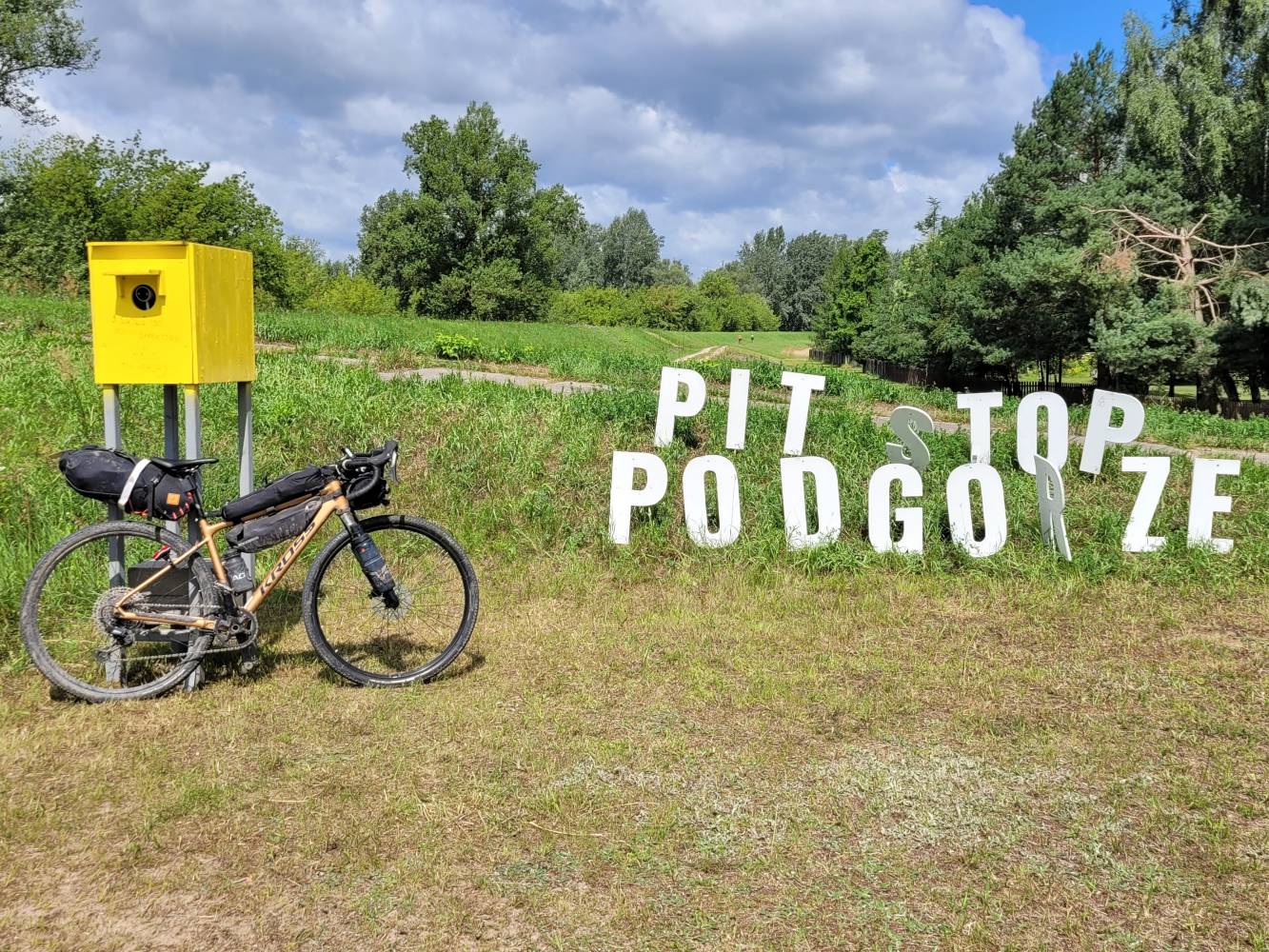
The Podgórze pit stop was connected with the event. There was hot water, soups, cookies and a place to stop for a while. There was even a camera where we could share a message with organisers. On a day like that, a pit stop doesn’t need much more. It only needs to give riders a few practical things at the right time.
The canopy was collapsed. At the time, we thought it was simply folded down because there was no need to open it. Later we learned that it had collapsed because of the wind.
That explained the day better than another weather forecast.
Other riders had already started making their own decisions. Some had shortened the route after the previous day’s Otwock section. I understood that. Long-distance rides are full of official routes, original plans and ideal scenarios, but eventually everyone has to decide what keeps the ride possible.
For us, the next major target was Płock.
Płock was a food stop and a rest stop. We wanted to reach it for a proper break, somewhere around halfway or a bit further into the day. If we got there in reasonable time, the second part would still be long, but it would feel more controlled.
The approach was slow.
The wind was still there. At one point near Płock, on the levee, we were moving at around 10 kilometres per hour. That is a frustrating speed when the day still has a lot of distance left, but at least it was still movement.
Before town, the organiser’s route also sent us into sand in the rain. I don’t remember it as a major special section. It was just one of those choices that felt unnecessary in the moment. Wet, windy, tired, and then sand before a city where we wanted a proper stop.
Płock finally became exactly what we needed it to be.
Pizza, something to drink, a longer pause, and booking accommodation in Bobrowniki. We left again in the rain.
I later learned that Płock and Włocławek were not random large stops on this part of the river. They had been important Vistula ports. Zakroczym and Wyszogród also belonged to that old river network, even if their later importance changed. On Day 5, I was using these places in the most ordinary modern way: Żabka, pizza, bridge photo, accommodation booking. But they sat on an older working river.
WORTH KNOWING:
Płock and Włocławek as Old Vistula Ports
On the Mazovian section of the Vistula, Płock and Włocławek were among the important river ports of the late medieval and early modern period. Chwalba writes that until the end of the 15th century, Płock, together with Radziwie on the opposite bank, and Włocławek belonged to the most important ports on this part of the river.
Warsaw, Zakroczym, Wyszogród and Nieszawa formed another group of river places. By the mid-16th century Warsaw had become the largest port, while Płock and Włocławek remained among the larger ones and Zakroczym and Wyszogród lost importance.
That’s what I like about this kind of ride. You don’t always understand a place while you’re there. Sometimes you only pass it tired and wet. Later, when you check the background, the route starts to look different.
After Płock, the road didn’t become easier.
There was a section of about 20 kilometres on a state road, a regional road rather than a national trunk road. It wasn’t the heaviest kind of traffic, and the asphalt itself was good. Normally, on smooth road, we might have gained some speed.
But not that day.
The wind and rolling sections drained energy. Cars were passing. It wasn’t a pleasant section, but it did one useful thing: it kept us moving. After mud, wind and slow levees, even an unpleasant road can still have one advantage. It moves the distance forward.
Further on, near the Dobrzyń area, the route became muddy again.
This was where we reached the place the organiser called Mostek pana Wiesława.
The name makes it sound like a proper bridge. It wasn’t. It was the organiser’s name, not a real place name, and it was not really a bridge at all. There were just wooden pieces laid across wet ground and small streams, enough to get through without stepping directly into the water.
It felt like something added to make our lives harder late in the day.
The organiser had said that when he checked the route a week earlier, the place was so overgrown that he could barely find it. By the time we arrived, faster riders had cleared enough of the path to make it passable. That didn’t make it pleasant. It was still muddy, awkward and slow.
But it was also exactly the kind of detail that stays in memory: not a monument, not a view, not a famous place, just a small named obstacle in the mud.
Włocławek became the next checkpoint.

We had chosen it ourselves, not because it was an official checkpoint, but because it had Żabka and because we needed a break before the final part towards Bobrowniki.
When we approached the city after the muddy sections, I saw the bridge and took a quick photo. It was partly documentary. I knew I had not taken many photos that day. The wind, rain and mud didn’t make me think about photography. The photo was simply something to remember Włocławek by.
That also fitted the day. Płock had been pizza and accommodation booking. Włocławek was Żabka and a bridge photo. These were old river places, but for us they were practical checkpoints on a hard day.

After Włocławek, we still had to reach Bobrowniki.
By then the day had narrowed down to the next practical thing. Food, wind, surface, distance, accommodation. The last part was about ending the day in a way that would let us start again in the morning.
Near Bobrowniki, the accommodation search became its own small story.
First we approached the firefighters’ house. There was nobody there, but a man was walking nearby, so we asked him if he knew about any accommodation. He said he would call someone.
A few minutes later, a firefighter arrived. Then the four of us, me, Andrzej and the two local men, started discussing options.
The firefighters’ place wasn’t possible. There were children there for the holidays, and the garage had new supplies inside, so they couldn’t even let us sleep on the floor.
We asked about the priest and whether there might be a possibility of staying near the church. That also failed. The priest was away on holiday, and the lady who looked after the church lived somewhere else. She only came to clean the church and the priest’s house.
Then someone suggested a small barracks at the local municipal waste collection point, known in Poland as a PSZOK.
That was the point when we decided we should return to the original plan. Maybe the PSZOK option would have worked, but it didn’t sound like a first choice. After a day of wind, rain, mud and traffic, we didn’t want to test that idea.
So we went back to the agroturystyka plan, even though it meant cycling another five or six kilometres off route, towards a place in the forest. Google chose the shortest way, which of course meant forest and sand. It was a fitting ending to the day.

That was how Day 5 ended: not with a big view, but with local phone calls, failed options and a ride off route to sleep somewhere usable. It wasn’t the most scenic day of the ride. It was wet, windy and logistical. That is probably why the idea of the working river fitted it so well.
The next morning, we would have to return from the agroturystyka to the route and ride towards Toruń, Chełmno and Grudziądz. The old towns of the lower Vistula were waiting, but first there would be more sand, bushes and levees.
Sources Used
- Andrzej Chwalba, Wisła. Biografia rzeki. Wydawnictwo Literackie, 2023.
- PTTK Mazowsze – Miejsce przeprawy wojsk Jagiełły
Next Reads
Wisła 1200: Poland Looks Different from the Vistula
The overview of my ride along the Vistula.
Wisła 1200: The Old Towns Broke the Monotony
The sixth day of the Wisła 1200 ride.