
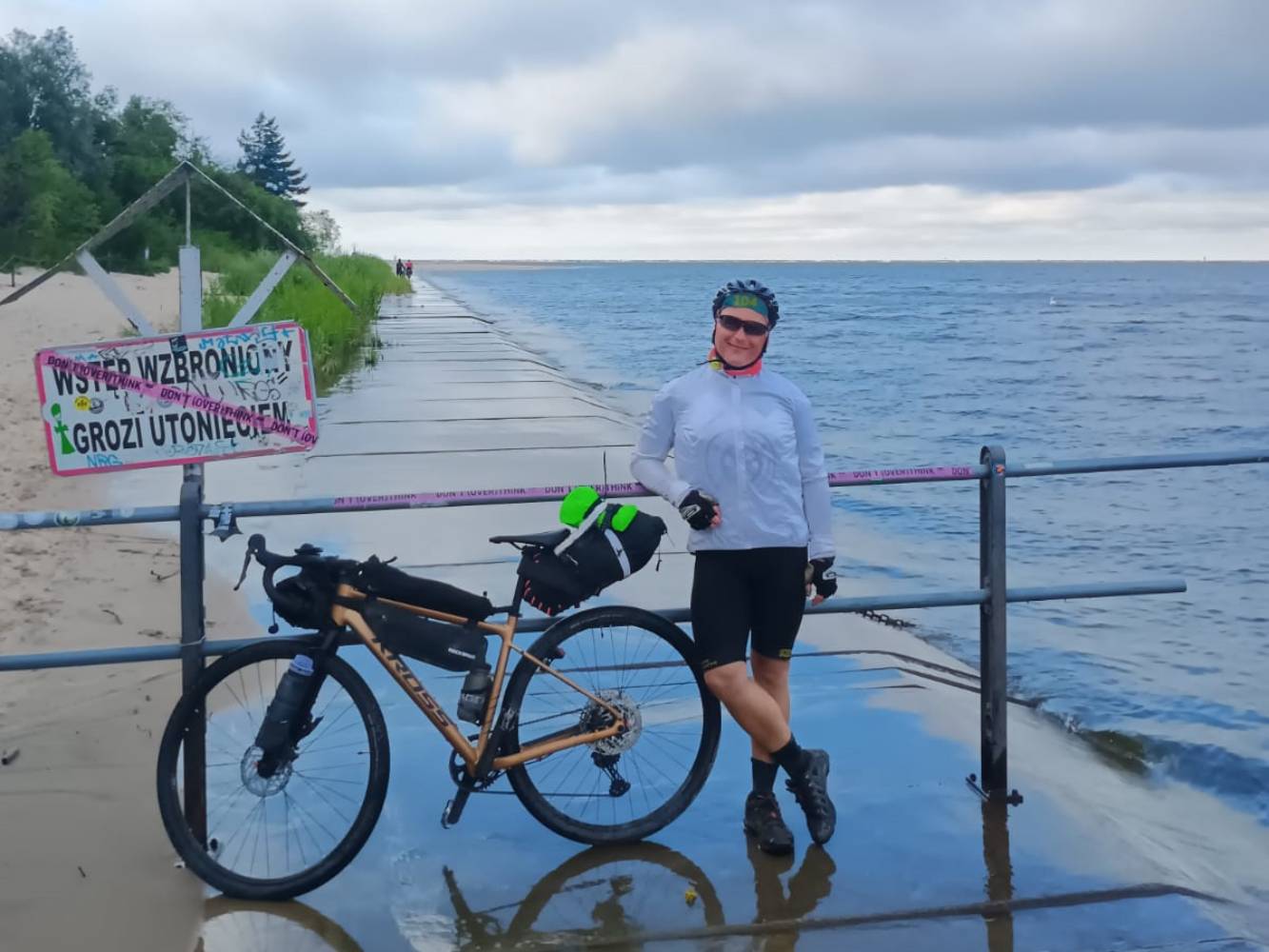
The official finish was in Gdańsk, but the ride reached its real ending earlier, at the Vistula mouth near Świbno.
Trip date: 10 July 2026
Route: Grudziądz – Gniew – Tczew – Świbno / Vistula mouth – Gdańsk
Distance: 147 km
The first tough section of the final day was still inside the building.
Our apartment in Grudziądz Old Town had a steep staircase with shallow steps. We had noticed it the evening before, so it wasn’t a surprise in the morning. It was still annoying with a loaded bike.

Older buildings aren’t designed like new ones. That is part of their character, but at 6:40 in the morning, after six days of riding, I was mostly interested in not dropping the bike.
For a moment after waking up, I had the pleasant thought that it was already over. As if we were already in Gdańsk and didn’t need to cycle anymore.
Then I remembered that there was still one more day.
It wasn’t a real doubt about finishing. We had about 150 kilometres left, and by then that didn’t sound like a question. We were going to ride it. The only question was how slowly, and what time we would arrive.
I knew we would finish that day. I just didn’t want to start.
The first named obstacle was Góra Łosiowa.
We knew it was coming because the organiser had spoken about it with too much satisfaction. There was apparently a bike path at the foot of the hill, but the route didn’t take it. The route climbed the hill instead. He had said riders would curse him on the way up and enjoy the view afterwards.
By Day 7, I didn’t have much energy for enjoying the view. We climbed it because it was part of the route.

The approach was open, with fields and the hill in front of us. It was not a mountain climb in the usual sense, but it was steep enough that we had to push the bikes in places. On the final morning, that was enough.
At Góra Łosiowa, we took a quick photo on the bench. It was more for memory and the photo library than for rest. We still had almost the whole day ahead.
After Góra Łosiowa, the route continued. I don’t remember it as a clean reward after the climb. The wind soon became the main thing.
The bridge near Kwidzyn became our last crossing of the Vistula on the whole ride. After a week of crossing and re-crossing the river, that should have felt like a clean milestone.
Instead, I remember the wind.

Even on the descent from the bridge, the bike slowed down when I stopped pedalling. That is a clear kind of headwind. You expect the bike to roll, and it doesn’t.
Ventusky showed gusts around 41 kilometres per hour. It wasn’t constant wind at exactly that speed, but the gusts came often enough that it felt almost continuous. The river, the fields and the open sections gave the wind plenty of space.
Towards Gniew, the day kept moving slowly.

Gniew marked another practical stage. We rode through the castle area and the town. Around the 50 kilometre mark, Andrzej found a bakery. We stopped for cakes, coffee and 15 or 20 minutes of rest.
Gniew deserved a few historical words, even if for us it was mostly a short stop. The town sits near the place where the Wierzyca meets the Vistula, and its castle is one of the strong brick reminders of the lower Vistula’s Teutonic past. On Day 7, we only passed through the castle area and stopped for cakes and coffee, but the place still fitted the final stretch of the route: another old river town on the way to the mouth.
Then the wind pushed back again.

At some point we had to stop on the grass. It wasn’t planned. We needed a break because of the wind.
The strange thing about that day was that I knew we would finish. There was no serious question about that. But knowing you will finish doesn’t make the kilometres disappear. It only changes the problem. The question becomes: how long will this take, and how much more annoying can the route still get?
Tczew was the last proper rest stop before the final approach.

The restaurant was convenient because it was directly on the route. We didn’t have to leave the trail to sit down properly. It also had a good view: the Vistula, and the historic bridge visible through the window.
I had been to Tczew before. I had started a few Kashubian rides there, and I had seen the bridge before. The old Wisła bridge at Tczew opened in 1857 and is one of the important 19th-century crossings in the lower Vistula story.
WORTH KNOWING:
The Tczew Bridge
The old Wisła bridge at Tczew opened on 12 October 1857. It was built as one of the major structures of the Prussian Eastern Railway, linking the Berlin-Königsberg route across the Vistula. ASCE describes it as the first long-span beam bridge on the European mainland. Pomorskie.Travel notes that the original bridge had six spans, neo-Gothic towers and portals, and that only part of the original 1857 structure survived the damage of the Second World War.
But on that day, Tczew was mostly food, drink, sitting down and preparing for the last difficult section.
That section was Tczewskie Łąki.
I had hoped it would be simple gravel. It wasn’t.
Most of the section was grass, slow riding and distance. About 12 to 15 kilometres of it. On another day, maybe it wouldn’t have stayed in memory so strongly. On Day 7, after Tczew, when the finish was already imaginable, it felt far too long.
It wasn’t one spectacular obstacle. It was worse in a quieter way. It kept going.
By then I wanted the route to become simple. Asphalt, gravel, anything steady. Instead, Tczewskie Łąki gave us slow grass and mental fatigue.
After that, the route finally started to move towards the real ending of the river.
The final kilometres to the Vistula mouth weren’t smooth either. Near the cypel, there were rocks, water and awkward walking. Carrying the bike was only a few metres at a time, but it happened more than once. The rocky section may have lasted around a kilometre.
Walking through water and over rocks in SPD shoes was not how I imagined finishing the Vistula part of the ride. I was careful because slipping there would have been stupid and unnecessary. After almost the whole route, I didn’t want to twist an ankle near the end.
Then we reached the mouth.
That was the important moment.
At the Vistula mouth I felt that we had done the main thing. We had followed the river from the source area near Barania Góra to its end.
The ride wasn’t over.
The river was.
The place itself also fits the wider story of the Vistula, because the modern main mouth near Świbno is connected with Przekop Wisły, often rendered in English as the Vistula Cut. Even at the mouth, the river wasn’t only nature. It was also engineering, flood control and human decisions.
WORTH KNOWING:
Przekop Wisły, the Vistula Cut
The present main mouth of the Vistula is connected with Przekop Wisły, often rendered in English as the Vistula Cut. It is an artificial channel between Świbno and Mikoszewo.
Gdańsk’s district history describes how the Vistula gained a new bed from Przegalina to the Gulf of Gdańsk when the cut opened on 31 March 1895. The new channel was about 7 kilometres long, 250-400 metres wide, and protected by embankments.
The aim was practical: give the river a straighter route to the sea and reduce flood danger for Żuławy and Gdańsk.
There were still about 20 kilometres left to the official finish. That was the strange part. The river had ended, but the ride had not.
We still had Wyspa Sobieszewska gravel, Gdańsk paths, cobbles and the final approach. At that point, the distance wasn’t frightening, but it was still distance. Knowing it was almost done didn’t finish it for us. We still had to ride the remaining kilometres.
Finally, we reached the official finish.

We collected the medals and took the photo with the board.
The official time was 156 hours and 53 minutes. The exact number didn’t matter much in the moment, but finishing inside the 170-hour limit did. We had about 13 hours to spare, and that felt good.
The finish mattered for a practical reason: it meant we could stop.
I took the bike to the car. Then Monika and I went back to the finish area, had something to eat and drink, and afterwards went to the accommodation.
There was no need to make the ending bigger than it was.
The river had ended at Świbno. The official finish had closed the ride. We had medals, food, a place to sleep and no alarm for another 5:30 start.
That was enough.
Sources Used
- Andrzej Chwalba, Wisła. Biografia rzeki. Wydawnictwo Literackie, 2023.
- Mateusz Waligóra and Dominik Szczepański, Szlak Wisły. 1200 km pieszej przygody. Wydawnictwo Otwarte, 2023.
- Gedanopedia.pl, Przekop Wisły
- National Maritime Museum, Regulations of the Vistula delta in the 19th and 20th centuries
- ASCE.org, Old Wisla Bridge
- Pomorskie.travel, Tczew Bridges