
Trip date: 4 April 2026
Route: Augustów – Nowy Dwór – Sokółka – Wasilków
Distance: 96 km
Area: Podlasie, north-eastern Poland
Back to Augustów
On Friday after work I took the train to Augustów in north-eastern Poland. I stayed at Stacja Wypoczynku again, about 50 metres from the railway station.
I had used the same place the previous year, and there was a simple reason for returning: it was convenient. I knew where I was sleeping, what was in the room and where I would start the next morning. I was arriving on the last train anyway, so noise from the railway wasn’t much of a concern.
The Saturday plan was also familiar. I wanted to reach Wasilków again, but by a different route that would add a few new gminas – local municipalities – to my map. Last year I had used the road bike. This time I was on the XC bike.
I divided the planned 150 kilometres into three roughly equal sections: Augustów to Nowy Dwór, Nowy Dwór to Sokółka, then Sokółka to Wasilków.
I woke at five, which is normal for me, and started around six. It was already getting light. The roads were quiet and I could hear birds.
It was also around 0°C, with a feels-like temperature of about -2°C.
My gloves are intended for temperatures above zero, and my hands quickly noticed the difference. On some stretches I rode with one hand on the handlebars while moving the other around to get the blood circulating again.
After seven it became more comfortable, but the wind cancelled out much of the improvement. I had brought lighter clothing for later in the day, but every layer I put on that morning stayed on until the end.

The first 20 kilometres were mostly cycle paths and tarmac. Around kilometre 19 I turned into the forest and immediately preferred the riding there. Maybe it was simply because the XC bike suited that surface better, but the asphalt had already started to feel tiring.

Not long afterwards came the first historical stop.
The bunkers I almost missed
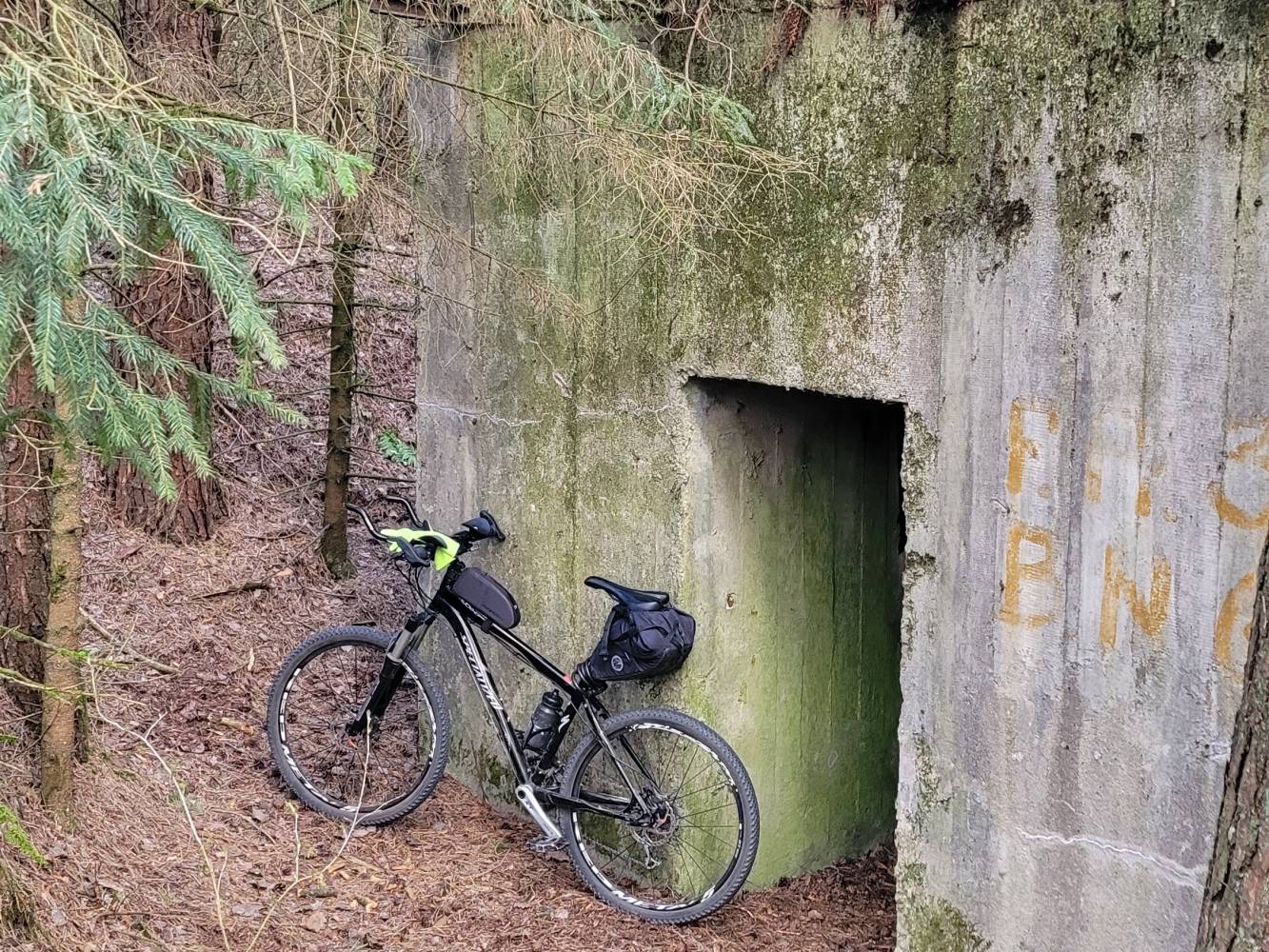
I knew there should be bunkers somewhere around the 30-kilometre mark.
I still rode past them.
Once I realised they should have been nearby, I turned around. They were slightly off the road and partly overgrown, but not particularly hidden. I had simply missed them.
There were two concrete shelters. I took a few photos, looked around and continued.

They were part of the Soviet fortification system commonly called the Molotov Line, built along the USSR’s new western frontier in 1940-41 after the border had moved west.
I had already seen similar bunkers elsewhere in Poland. What interested me here was finding them beside an ordinary forest road and then placing them back into that short period when this area stood beside a newly created Soviet border.
A cross near Dulkowszczyzna
Further south I stopped at a roadside cross near the Dulkowszczyzna crossroads.

I haven’t found a verified connection between the cross itself and the story, but the name Dulkowszczyzna led me to something much more substantial.
During the German occupation, Anna and Stanisław Krzywicki hid Meir Trachtenberg, his wife and their son after the family escaped from the Grodno ghetto in 1943. The Krzywickis prepared a hiding place at their farm, their children helped, and the Trachtenbergs remained there for more than a year.
Anna and Stanisław Krzywicki were later recognised as Righteous Among the Nations.
Nowy Dwór
The first 50 kilometres had gone reasonably well. The terrain was fairly flat and the headwind hadn’t yet become the main problem of the day.
In Nowy Dwór I passed the Catholic Church of St John the Baptist and the Orthodox Church of St Nicholas.
The Catholic parish is linked with 1504, while the present church dates mainly from the nineteenth century.

Orthodox churches always stand out to me. We have them in Warsaw as well, so they aren’t unfamiliar, but I still associate them strongly with eastern Poland. Otherwise, many of the villages I was riding through didn’t look particularly different from villages I know in Mazovia.

After Nowy Dwór, the cycling became much harder.
The second 50 kilometres
From roughly kilometre 50 onwards, the wind was almost constantly in my face.
The terrain also became hillier. When I checked the elevation profile afterwards, there was a stretch of almost 30 kilometres that was generally climbing.
The combination was enough to bring the pace down. The first 50 kilometres had been relatively straightforward. The second 50 felt very different.

Siderka
At Siderka I passed an old brick water mill dating from the second half of the nineteenth century.

Nearby was the Church of Divine Providence.
Nearby was the Church of Divine Providence. It was built in 1825 for the local Greek Catholic community. After the Union was suppressed in this part of the Russian Empire, the church was eventually transferred to the Orthodox Church in 1850. After Poland regained independence, the building became Roman Catholic in 1920.
So this wasn’t simply a church that changed denomination over time. The changes followed much larger political and religious shifts in the region, while the same building remained in place.

Sidra
A few kilometres later came Sidra, where several different traces of the past appeared close together.
On the road towards the town I stopped at the Jewish cemetery. It dates from the second half of the nineteenth century, and I photographed one of the surviving headstones.

In Sidra itself I passed Holy Trinity Church and the remains of a former fortified residence connected with the Wołłowicz family, an important magnate family of the Grand Duchy of Lithuania. Eustachy Wołłowicz was involved in developing Sidra in the sixteenth century and established his residence there.

A little further along the route, the same family name appeared again at Pawłowicze.
Paweł Wołłowicz built a masonry residence there in 1610, although the building was altered and reconstructed later. What interested me more was the connection itself: two places I had passed separately turned out to belong to the story of the same Lithuanian magnate family.
Starowlany
Near Starowlany I stopped at a small nineteenth-century cholera cemetery.
There was much less to see than at the churches or old residences, but the cemetery preserves a physical trace of the epidemics that affected local communities in the nineteenth century.
A memorial plaque was added there in 2018 for residents of Starowlany who died during those epidemics.

It’s the sort of place that would be very easy to pass without knowing why it was there.
Sokółka
By the time I reached Sokółka I was tired.
I stopped in front of the town hall to look for somewhere to eat.
Then it began to rain.
It was only light rain, but the wind had already cooled me down for much of the previous 50 kilometres. I still had on all the layers I had put on before leaving Augustów.
In the centre I also passed St Alexander Nevsky Orthodox Church, built in the middle of the nineteenth century.

The original plan still had around another 50 kilometres to go, much of it through Puszcza Knyszyńska before reaching Wasilków.
I did consider continuing. The final section was supposed to be flatter, but there would still be plenty of forest, so I was unlikely to make up much time there.
There was also the family Easter gathering. That was the main reason I was in Podlasie that weekend, and continuing by bike would make me late.
I had already collected all the gminas I had planned for the day.
For a moment I considered riding towards Bohoniki and its historic mosque of the Polish Tatars before making the final decision. After Catholic and Orthodox churches and the Jewish cemetery near Sidra, it would have added another very specific layer of Podlasie’s religious history.
But it was still raining.
Then I passed Sokółka railway station.
I chose the train.
96 kilometres was enough
Once I was on the train, there was no real disappointment. Mostly there was relief. I could sit down, recover and still reach the family gathering on time.
Stopping in Sokółka was the right decision.
The planned 150 kilometres became 96, but there had already been plenty along the way to look into afterwards – from the Soviet bunkers to Siderka’s changing church and the small cholera cemetery near Starowlany.
The last 50 kilometres through Puszcza Knyszyńska were still there.
Just not for that Saturday.
Sources Used
- National Heritage Board of Poland – Siderka water mill, Siderka church, Sidra heritage and Pawłowicze residence
- Archdiocese of Białystok – parish histories for Nowy Dwór and Siderka
- Orthodox Diocese of Białystok-Gdańsk – St Nicholas Orthodox Church in Nowy Dwór
- POLIN Museum, Polish Righteous project – Anna and Stanisław Krzywicki
- POLIN Virtual Shtetl – Jewish cemetery in Sidra
- Sokółka municipal heritage documentation – St Alexander Nevsky Orthodox Church
- Polish government heritage material – Bohoniki and Polish Tatar heritage